The story in brief
Farlight 84 product differentiation is the central theme of this case study. The game stood out through its jetpack-powered movement, hero abilities, vehicles, and battle royale combat. Its Version 2.0 update changed the movement experience, raising an important question about game identity, player sentiment, and retention.
1. The Rise of Farlight 84
Farlight 84 combined battle royale combat with hero abilities, vehicles, respawns, and jetpack-powered movement. That combination helped it stand out in a crowded shooter market.
Its jetpack wasn’t just another ability. It changed how players approached combat, allowing them to gain height, dodge attacks, reposition, and move across the battlefield differently.
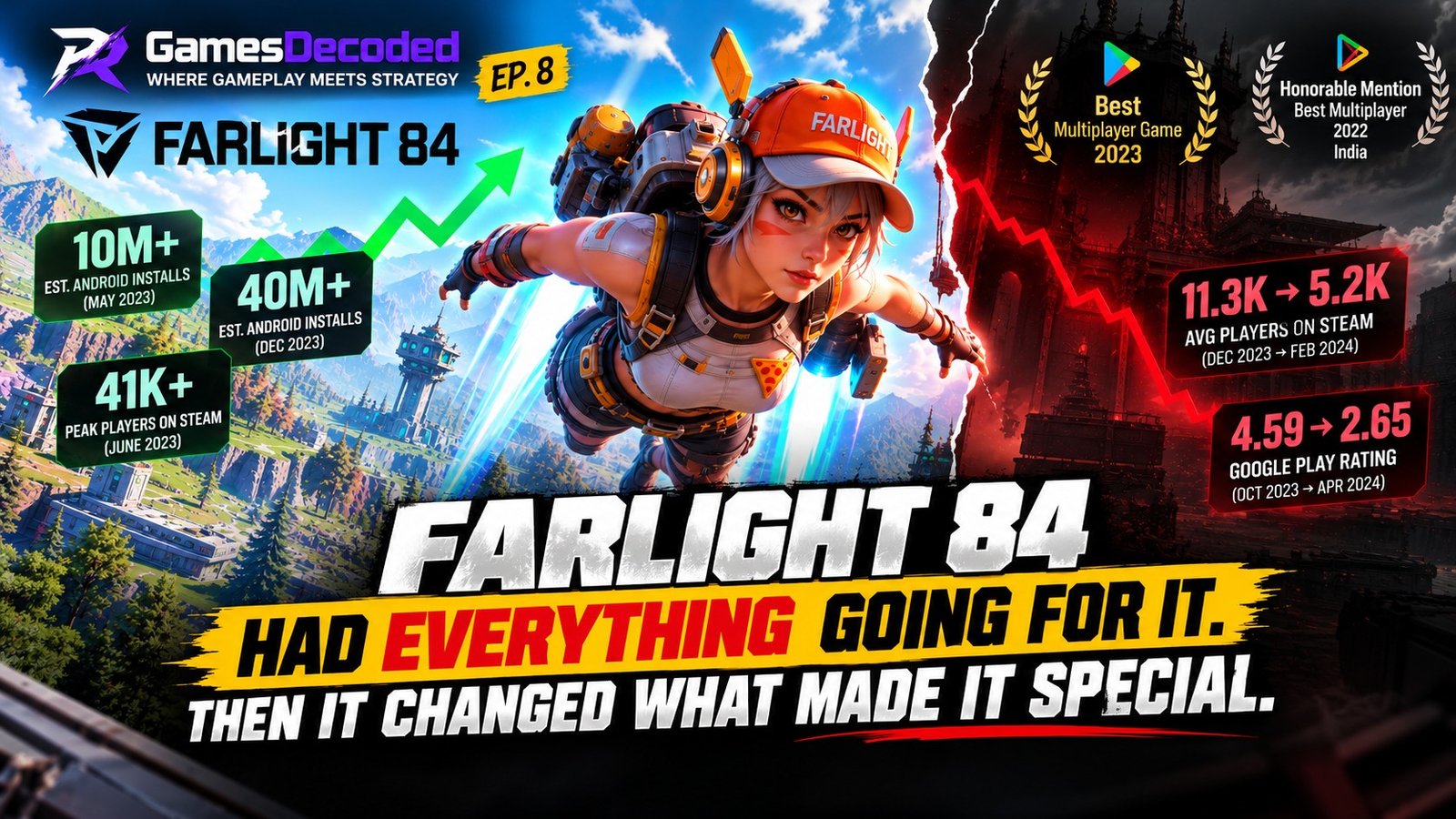
Best Multiplayer at Google Play’s Best of 2023.
Honorable Mention for Best Multiplayer in Google Play’s Best of 2022 in India.
A Steam peak of 41,396 concurrent players in June 2023.
Farlight had something valuable: a recognizable gameplay identity.
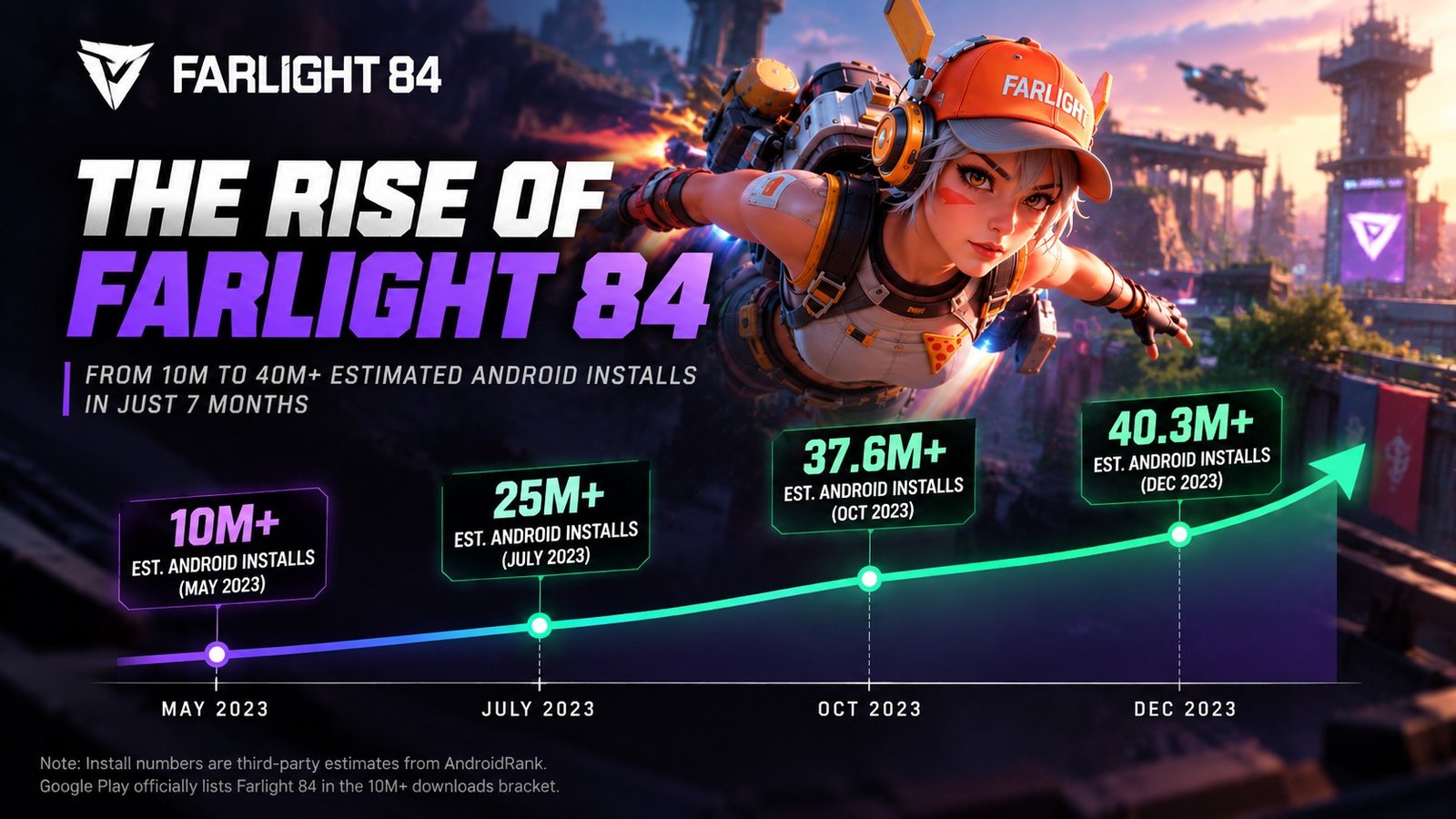
Graphic 2. Estimated Android install growth, based on AndroidRank historical estimates.
2. The Numbers Behind the Growth
Farlight’s early trajectory was impressive on both mobile and PC. Its estimated Android installs continued climbing, while its Steam audience surged after its April 2023 Steam launch.
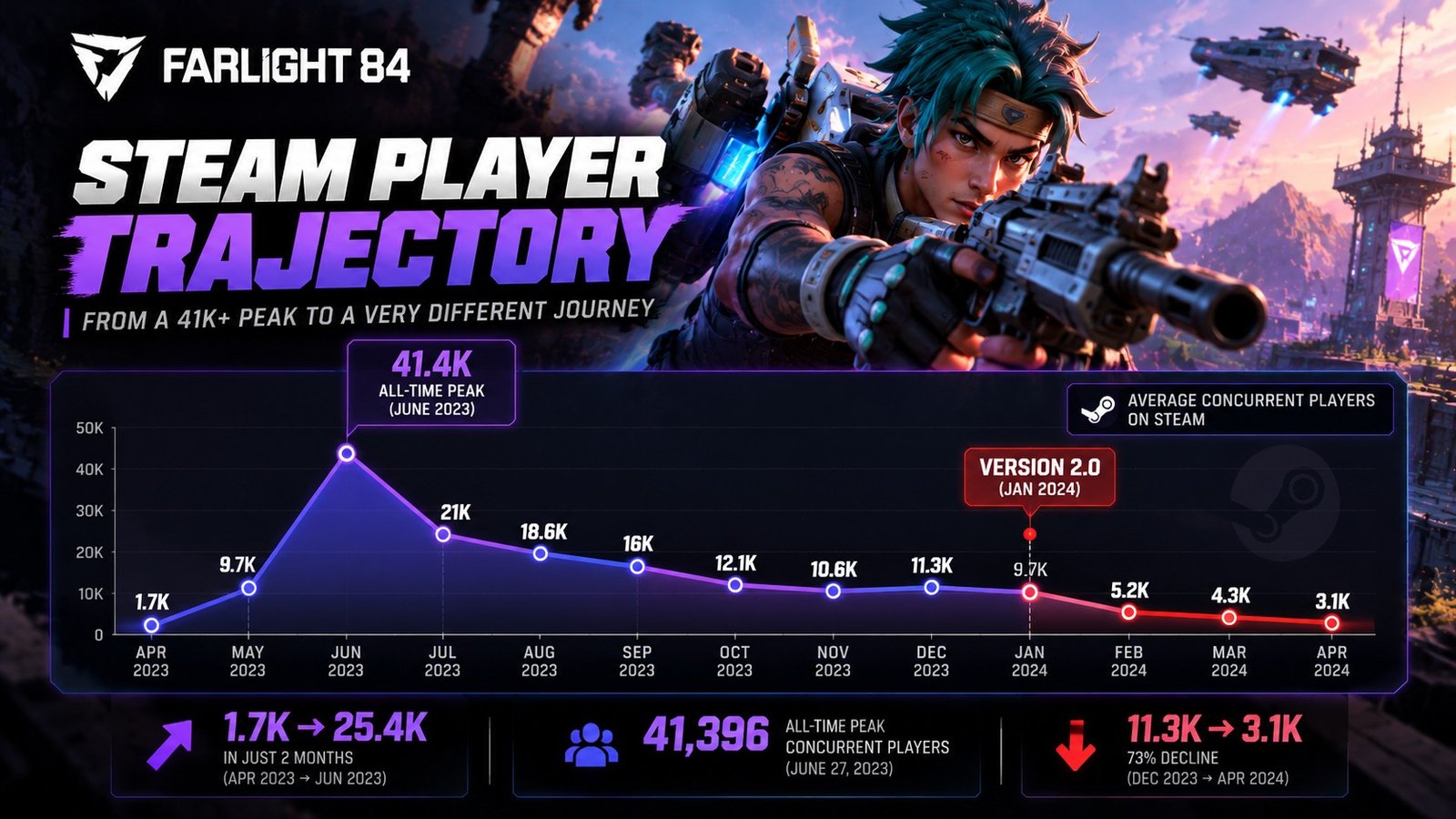
Steam average concurrent players:
| Month | Average concurrent players |
|---|---|
| April 2023 | 1,749 |
| May 2023 | 9,678 |
| June 2023 | 25,371 |
| September 2023 | 15,972 |
| December 2023 | 11,336 |
| January 2024 | 9,735 |
| February 2024 | 5,165 |
| April 2024 | 3,083 |
Farlight reached an all-time Steam peak of 41,396 concurrent players on June 27, 2023.
But there is an important detail: its Steam audience had already begun declining before Version 2.0 arrived. That matters because it prevents us from attributing the entire decline to one update.
Graphic 3. Steam player trajectory. The trend is notable, but it does not establish causation.
3. Farlight 84 Product Differentiation: What Made It Different?
Farlight’s appeal came from the combination of several systems: battle royale matches, hero-based combat, jetpack mobility, vehicles, and unique hero abilities.
The jetpack connected these systems by making movement a core part of combat. Players weren’t simply shooting, taking cover, and rotating around the map. They were using verticality and mobility to change how encounters played out.
That gave Farlight a clear answer to a crucial product question: Why should someone play this game instead of another battle royale?
It felt different.
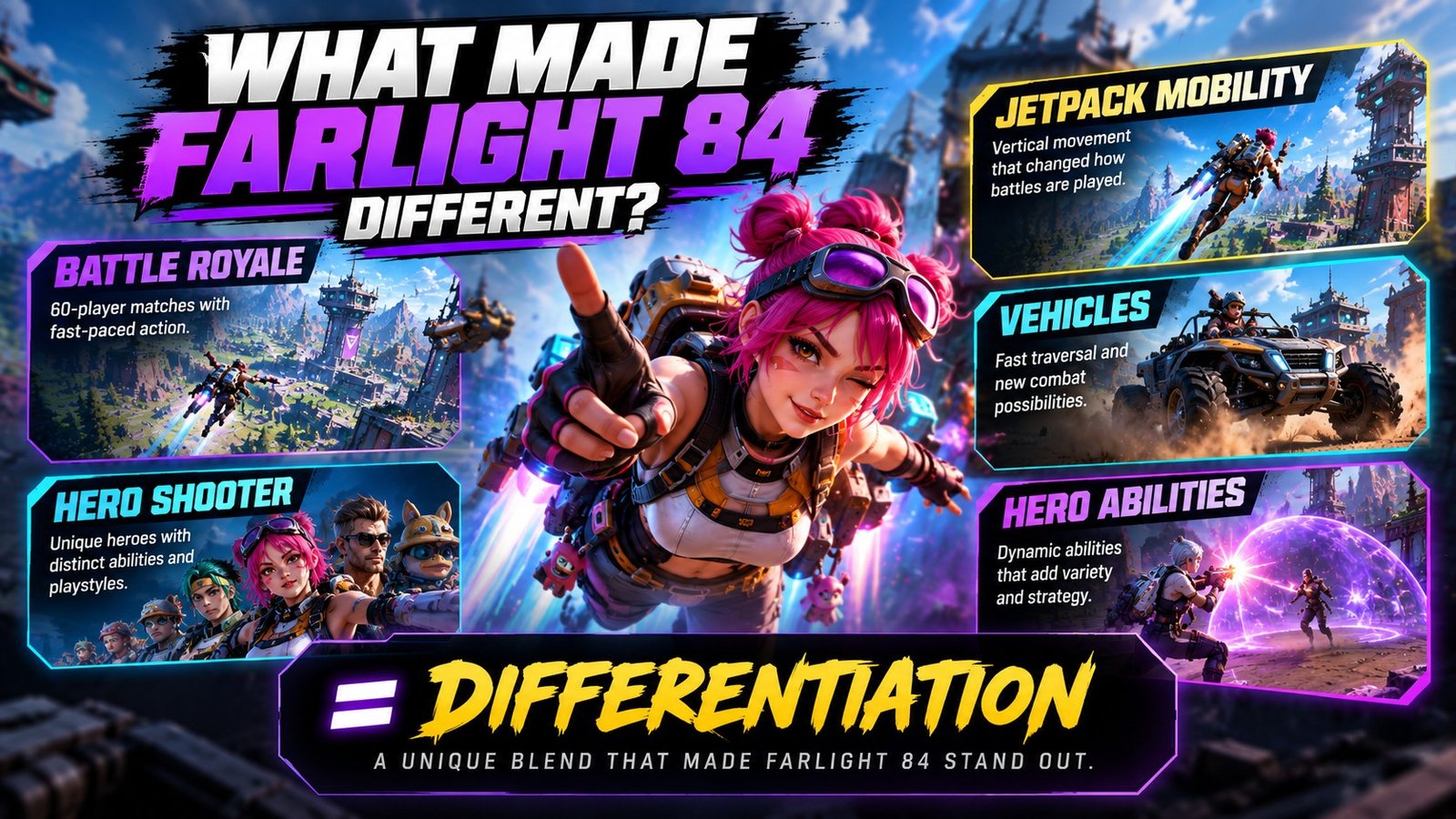
Graphic 4. The gameplay ingredients that helped Farlight stand out.
4. Farlight Was Building an Esports Ecosystem, Too
In August 2023, Farlight announced a US$20 million, five-year esports investment commitment in the Philippines.
The plans included the Farlight Philippines Championship and tournament opportunities offering access to prize pools of up to US$1 million across the planned competition program. The US$20 million was the investment commitment, not the prize pool.
The strategy showed that Farlight was trying to build a competitive ecosystem around the game, not just acquire players. It had growth, recognition, a distinctive mechanic, and esports ambitions.
Then came Version 2.0.
5. January 2024: The Movement System Changes
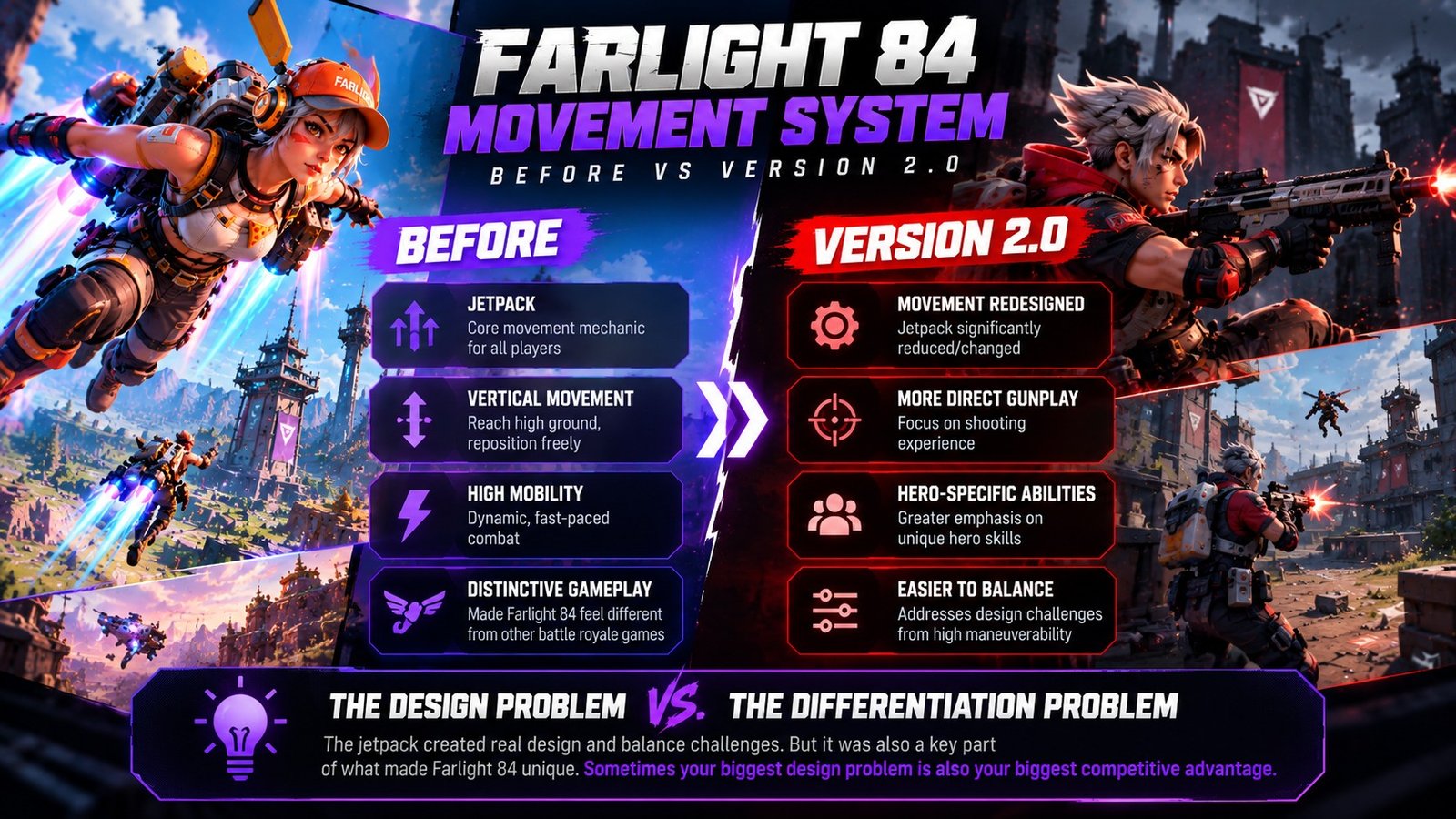
Version 2.0 significantly redesigned Farlight’s movement system. The jetpack wasn’t completely removed, but its role changed substantially. Some heroes retained jetpack capabilities, while the broader movement experience shifted.
The developers explained their reasoning in the Version 2.0 notes: the jetpack’s high maneuverability created compromises in shooting and hero-skill design. Their goal was to improve direct combat and create more room for distinctive hero abilities.
From a design perspective, that concern was understandable. High mobility can make combat difficult to balance and create challenges for weapon design, counterplay, and hero differentiation.
But was the jetpack simply a balance problem, or was it part of Farlight’s competitive advantage?
Graphic 5. Version 2.0 reframed the movement experience and raised a trade-off between design control and differentiation.
6. What Happened Next?
The timing is notable, although it doesn’t establish causation. Steam’s average concurrent player count fell from 11,336 in December 2023 to 3,083 in April 2024, a decline of roughly 73%.
Meanwhile, AndroidRank’s historical Google Play rating data shows:
| Period | Average rating |
|---|---|
| October 2023 | 4.59 |
| December 2023 | 4.29 |
| February 2024 | 3.18 |
| April 2024 | 2.65 |
These figures point to a period of declining Steam activity and deteriorating mobile ratings. They do not prove that the movement redesign alone caused either trend.
Other factors—including content cadence, competition, matchmaking, technical issues, and monetization—may also have contributed.
The more useful observation: Farlight’s audience metrics and player sentiment were moving in different directions.
AndroidRank estimated that Android installs continued increasing, reaching approximately 45.7 million by April 2024. A game can continue attracting new installs while existing players become less satisfied.
Acquisition is not retention.
7. The Real Lesson: Don’t Optimize Away Your Differentiation
The lesson isn’t that developers should never change popular mechanics. It’s that they need to understand what those mechanics mean to players before redesigning them.
A development team might see the jetpack as a balancing challenge, a shooting compromise, or a constraint on hero design. Players might see it as the reason Farlight feels like Farlight.
A mechanic can be difficult to balance and still be the reason players choose your game. Removing it might simplify development while making the overall experience less distinctive.
Before removing a defining mechanic, developers should ask:
What do players associate most strongly with our game?
Which mechanics make our gameplay recognizable?
Can we design better counterplay instead of removing the mechanic?
Are we solving a genuine player problem or primarily an internal design problem?
What do player reviews, community discussions, and retention data tell us?
Sometimes the better solution is to redesign maps, improve readability, introduce counters, adjust cooldowns, or restrict a mechanic to specific characters.
The objective isn’t to preserve every old feature forever. It’s to improve the game without accidentally removing its identity.
8. Farlight’s Attempt to Reclaim Its Identity
In 2025, Farlight’s global relaunch promoted new content, visual improvements, first-person mode, and a message that stood out: “Jetpack is BACK!”
That doesn’t prove the earlier redesign was the wrong decision. But it highlights how prominently the jetpack featured in the game’s identity and relaunch messaging.
A defining mechanic can be difficult to replace once players associate it with a game.
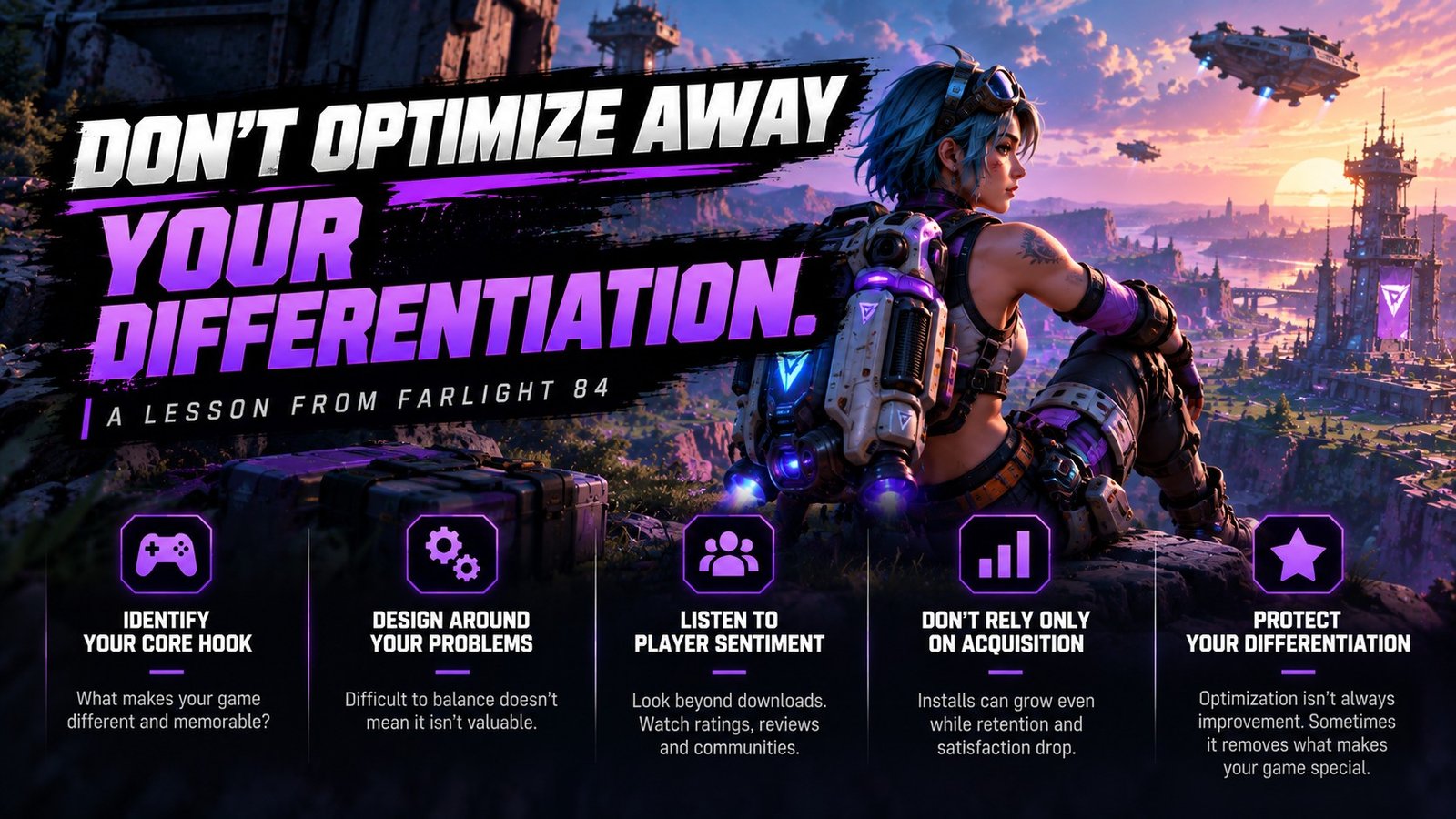
9. Five Lessons for Game Developers
Identify your core hook. Know what makes players choose your game over alternatives.
Separate design problems from product value. A mechanic being difficult to balance doesn’t mean players don’t value it.
Track sentiment alongside acquisition. Downloads alone cannot tell you whether the player experience is improving.
Understand player identity before major redesigns. Study reviews, community conversations, gameplay clips, and retention patterns before changing defining systems.
Design around problems before removing them. Explore counterplay and targeted adjustments before eliminating what makes the experience distinctive.
Graphic 6. The core lesson: don’t optimize away your differentiation.
Final Takeaway
Farlight 84 reached more than 40 million estimated Android installs, peaked above 41,000 concurrent Steam players, earned Google Play recognition, and invested in esports.
It also had a distinctive movement system.
The story isn’t that jetpacks killed Farlight 84. The evidence doesn’t support that conclusion.
The bigger lesson is that optimizing a game doesn’t always make it more memorable.
Balance can be improved. Bugs can be fixed. Content can be added. But if players lose the reason they chose your game in the first place, winning them back can be much harder.
Your biggest design problem might also be your biggest competitive advantage.
GamesDecoded | Where Gameplay Meets Strategy
GamesDecoded is PlayRift’s gaming industry analysis series exploring the product decisions, growth strategies, monetization systems, and live-ops mechanics shaping the games industry.
Episode 8: Farlight 84 | Powered by PlayRift
Sources
Google Play: Best of 2023: https://blog.google/products-and-platforms/platforms/google-play/google-play-best-apps-games-2023/
Google Play: Best of 2022 in India: https://blog.google/intl/en-in/products/platforms/google-plays-best-apps-and-games-of-2022-in-india/
AndroidRank: historical install and rating estimates: https://www.androidrank.org/application/farlight_84/com.miraclegames.farlight84
SteamCharts: Farlight 84 player history: https://steamcharts.com/app/1928420
SteamDB: Version 2.0 developer notes: https://steamdb.info/patchnotes/13256873/
Farlight Games: global relaunch: https://activity-84.farlightgames.com/
ONE Esports: Philippines esports investment: https://www.oneesports.gg/gaming/farlight-84-new-filipino-hero-teaser/