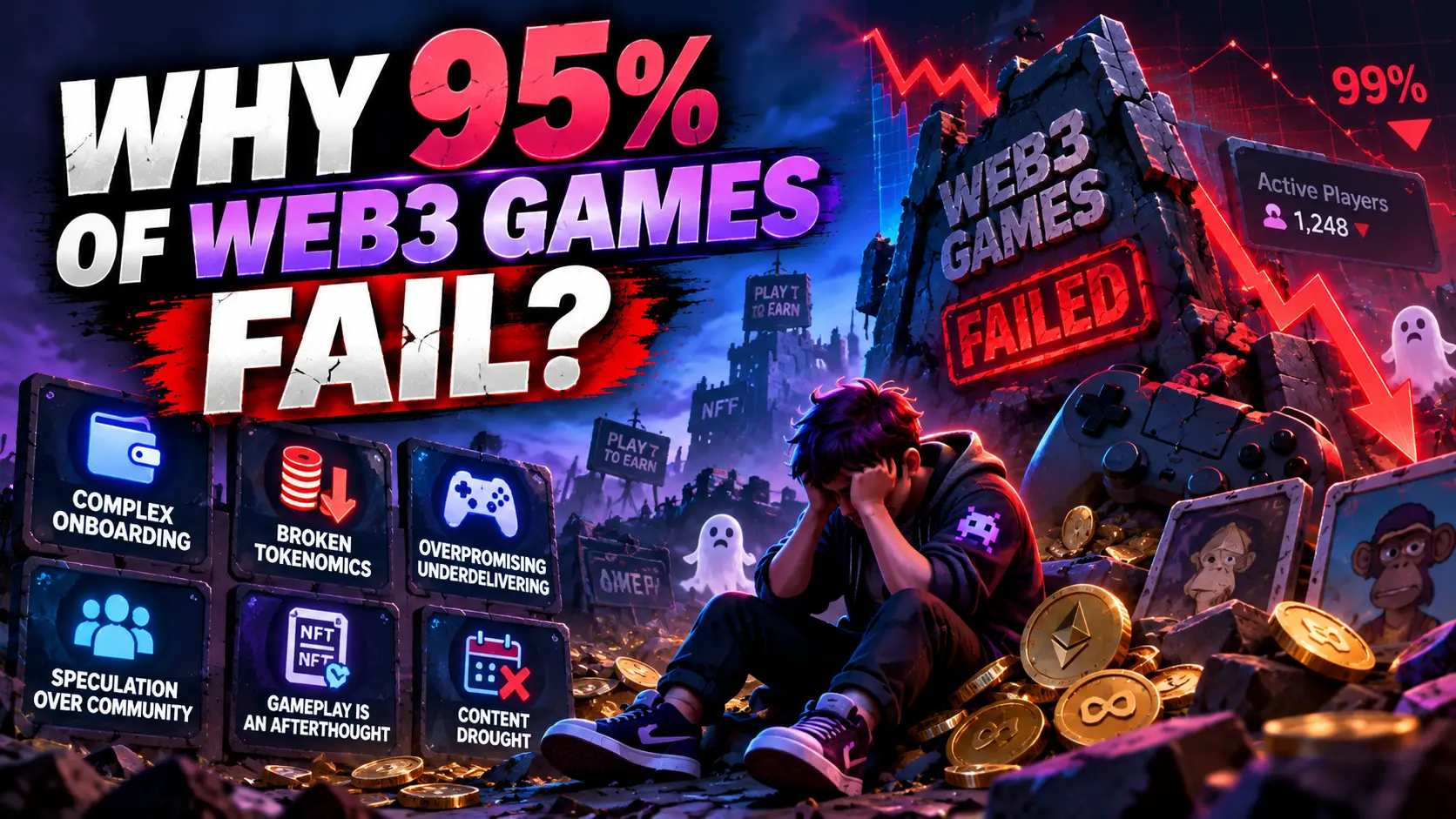
Why 95% of Web3 Games Fail?
Web3 gaming was supposed to be the next big thing.
Billions of dollars flowed into blockchain gaming. Projects promised player-owned assets, play-to-earn economies, NFT marketplaces, and gaming experiences that would redefine the industry.
But raising money and attracting early hype are not the same as building a successful game.
Many Web3 projects struggled to retain players after their initial launches, token campaigns, or NFT drops. Others failed to deliver the gameplay experience their marketing promised.
The result? A growing list of projects that lost user activity, abandoned development, or struggled to sustain their in-game economies.
The frequently cited claim that 95% of Web3 games fail should be treated carefully because failure rates vary by dataset, time period, and definition. For example, CoinGecko’s analysis of 2,817 Web3 games launched from 2018 to 2023 found that 75.5% had become inactive under its user-activity methodology.
But the bigger question remains:
Why do so many Web3 games struggle to survive beyond the initial hype?
Here are seven mistakes that help explain what went wrong.
Why Web3 Games Fail: 7 Common Mistakes:
1. Complex Onboarding: Making Players Work Before They Can Play
Most players want to experience a game before committing time, money, or personal information to it.
Yet some Web3 games introduce unnecessary friction before players can even begin playing.
Users may be asked to:
Create or connect a crypto wallet
Understand gas fees and blockchain transactions
Sign unfamiliar wallet requests
Acquire tokens or NFTs before accessing meaningful gameplay
Navigate multiple platforms just to start playing
Every additional step creates another opportunity for a potential player to leave.
Traditional mobile and PC games have spent years simplifying account creation and reducing friction. Web3 games often need to meet the same expectations.
A better approach is to let players experience the core game first, explain blockchain features when they become relevant, and make wallet creation or asset ownership as straightforward as possible.
The lesson: Reduce onboarding friction. Players should discover why the game is fun before they are asked to understand its financial infrastructure.
2. Broken Tokenomics: When the Economy Cannot Sustain Itself
Tokenomics became one of the most heavily discussed parts of early Web3 gaming.
But many game economies struggled when rewards, token supply, and actual player demand were poorly balanced.
A common pattern looked like this:
More players join for rewards → more tokens enter circulation → selling pressure increases → token prices fall → rewards lose their appeal → players leave.
This becomes especially problematic when the game relies on a constant stream of new participants to sustain the value of existing rewards.
Other risks include:
Excessive token emissions
Concentrated token ownership
Unclear vesting schedules
Weak reasons to spend or use tokens
Rewards that are not supported by sustainable demand
A token can create additional utility, but it cannot manufacture long-term demand on its own.
Successful game economies need to be designed around the player experience, with transparent supply mechanics, balanced rewards, and a clear reason for assets to exist within the game.
The lesson: Build a sustainable game economy before turning token rewards into the primary reason to play.
3. Overpromising and Underdelivering
Web3 gaming marketing often raises expectations before the product is ready.
Trailers showcase ambitious worlds. Roadmaps promise complex gameplay systems. Announcements describe next-generation experiences.
Then players encounter an unfinished product, limited features, poor optimization, or gameplay that feels disconnected from the original promise.
That gap between expectations and reality damages trust.
Players may forgive early bugs when a game is transparent about its development stage. They are less likely to remain engaged when major promises repeatedly go unfulfilled.
Studios can reduce this risk by:
Showing real gameplay instead of relying entirely on cinematic trailers
Setting realistic development milestones
Testing early versions with actual players
Communicating delays and limitations honestly
Prioritizing playable progress over repeated announcements
Marketing should communicate the value of the product—not create expectations that development cannot meet.
The lesson: Ship a compelling playable experience before selling players on a distant vision.
4. Speculation Over Community: Building Traders Instead of Fans
A game’s community should have reasons to exist beyond token prices and NFT sales.
Yet many Web3 communities become dominated by discussions about:
Upcoming token listings
NFT mint dates
Airdrop eligibility
Token-price speculation
Short-term profit opportunities
These topics can attract attention, but they do not necessarily create lasting interest in the game.
If players participate only because they expect a financial reward, engagement may disappear when that reward becomes less attractive.
A strong gaming community needs more than announcements about financial opportunities.
Players should have spaces to discuss gameplay, share strategies, report bugs, create content, participate in events, and influence the development process.
Developers should measure whether community members are actually playing, returning, and interacting—not simply joining a Discord server.
The lesson: Build a community around the game itself. Financial incentives can complement the experience, but they should not replace it.
5. Gameplay Comes Second
This is one of the most fundamental mistakes in Web3 gaming.
Some projects invest heavily in token launches, NFT collections, partnerships, and marketing before establishing whether their core gameplay is enjoyable.
But players do not continue playing a game simply because its assets are tradable.
They return because the experience gives them reasons to return.
That means investing in:
A satisfying core gameplay loop
Responsive controls and reliable performance
Meaningful progression
Interesting challenges and rewards
Multiplayer systems that encourage repeat play
Playtesting before a major launch
Blockchain features may introduce genuine value through asset ownership, trading, or player-driven economies. However, those features need to support an experience that players already want to engage with.
The lesson: Build the game first. Add Web3 mechanics where they improve the experience, rather than expecting them to compensate for weak gameplay.
6. Content Drought: What Happens After the Launch Hype?
Launching a game is only the beginning.
Players need new reasons to return after completing the initial content or losing interest in the first gameplay loop.
Some Web3 teams focus heavily on token generation events, NFT launches, airdrops, and early community campaigns—but provide limited gameplay updates afterward.
Without meaningful content, even an initially enthusiastic audience can lose interest.
A long-term content strategy may include:
New missions, maps, characters, and gameplay modes
Seasonal events and competitive challenges
Regular balance updates
Community tournaments
Creator partnerships and user-generated content
Transparent development roadmaps
Updates should give players something meaningful to experience, not merely another announcement to read.
Studios should also track retention metrics across cohorts, including Day 1, Day 7, and Day 30 retention, to understand whether new features are encouraging players to return.
The lesson: A launch campaign attracts attention. Consistent product development gives players reasons to stay.
7. Misaligned Incentives: When Trust Becomes the Biggest Problem
Web3 projects often ask communities to trust teams managing large treasuries, token allocations, NFTs, and future development plans.
That trust becomes difficult to maintain when financial incentives are unclear.
Warning signs can include:
Opaque token allocations
Unclear founder and investor vesting schedules
Repeated roadmap changes without accountability
Marketing claims that exceed actual product progress
Token unlocks that are poorly communicated
Limited transparency around development spending
It is important not to assume that every Web3 founder acts in bad faith. Teams need compensation and funding to build products.
The problem arises when incentives encourage short-term extraction instead of long-term product development.
Transparent allocations, clearly communicated vesting, measurable milestones, responsible treasury management, and ongoing delivery can help align a team’s interests with those of its players.
The lesson: Trust must be earned through transparent decisions and consistent execution—not just promised in a whitepaper.
What Successful Web3 Games Should Do Differently
The failures of earlier projects offer practical lessons for developers entering the space today.
1. Make the Game Fun Without Financial Incentives
A player should still have reasons to enjoy the game if token rewards temporarily disappear or become less valuable.
2. Simplify the First-Time User Experience
Reduce unnecessary wallet friction, explain blockchain features clearly, and allow users to experience the core gameplay with minimal setup.
3. Design Sustainable Economies
Token supply, rewards, asset utility, and player demand should work together instead of depending entirely on continuous new investment.
4. Prioritize Retention Over Vanity Metrics
Downloads, wallet connections, token holders, and Discord members tell only part of the story.
Measure active players, repeat sessions, cohort retention, content engagement, and organic community participation.
5. Build and Communicate Consistently
Publish realistic roadmaps, test new features, listen to player feedback, and keep delivering meaningful improvements after launch.
6. Align Team Incentives With Long-Term Success
Clear ownership structures, transparent vesting schedules, responsible treasury practices, and accountable development milestones can help build community trust.
Final Thoughts: Web3 Gaming Needs Better Games, Not Just Better Tokens
The Web3 gaming industry does not have a technology problem alone. It has also faced challenges involving product quality, onboarding, economic design, community management, and player retention.
Blockchain technology can enable digital ownership and new economic systems. But those features do not automatically create a compelling game or a sustainable business.
The projects most likely to earn long-term players are the ones that treat gameplay, community, and economic design as connected parts of the same product.
The real question is not whether a game needs a token. It is whether the game gives players a reason to stay after the initial hype disappears.
What do you think is the biggest reason Web3 games fail: poor gameplay, unsustainable tokenomics, or teams prioritizing speculation over players?
Share your perspective in the comments.