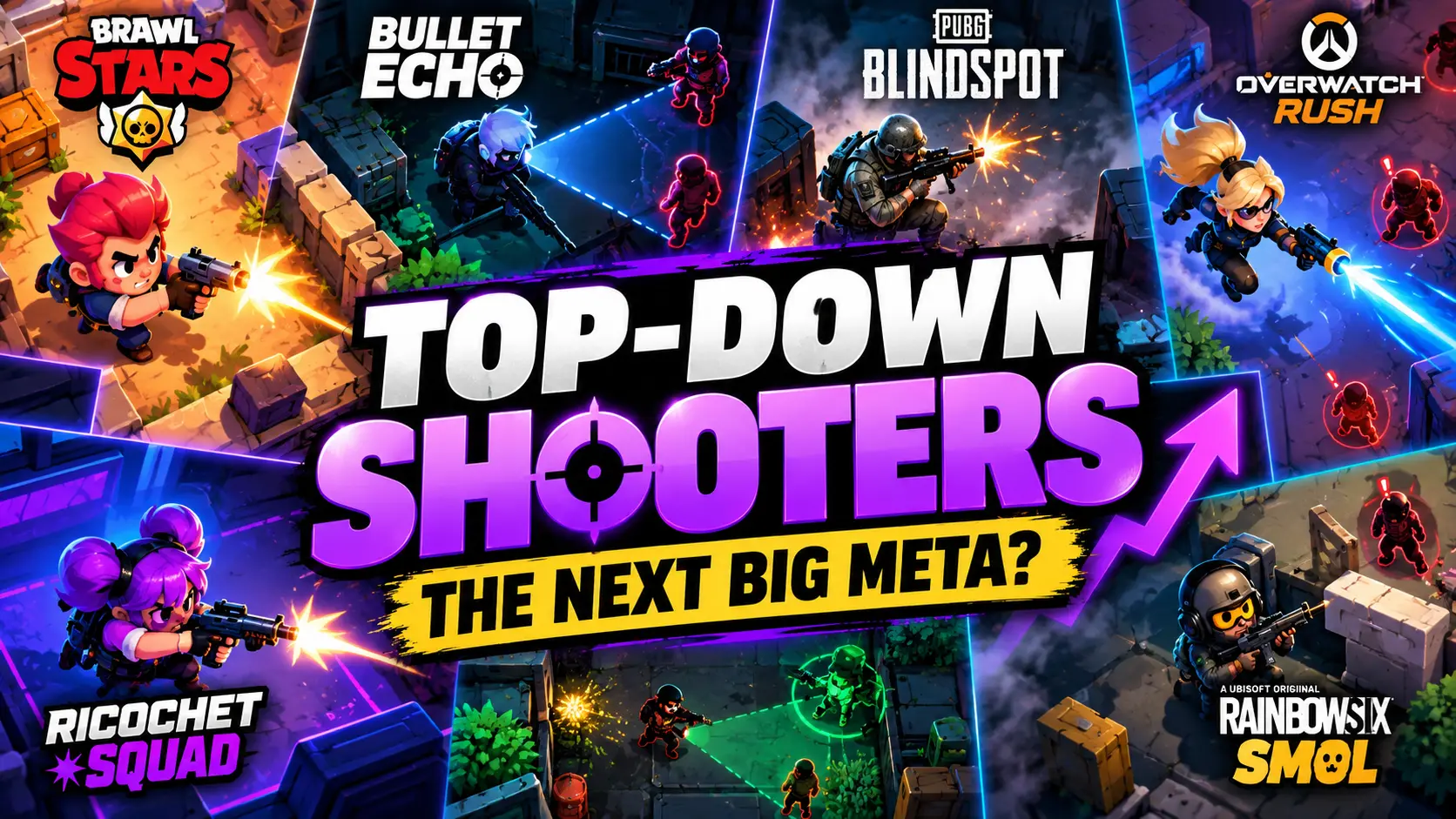
Top-Down Shooters: The Next Big Meta?
For years, Brawl Stars has been one of the defining games in the top-down mobile shooter space. Its combination of fast-paced matches, simple controls, and competitive gameplay helped establish a strong formula for mobile gaming.
But the genre is evolving.
From tactical team shooters like Bullet Echo to new mobile experiments like Overwatch Rush, developers are exploring different ways to make top-down combat work across platforms and audiences.
Some experiments have already launched. Others are still evolving, while a few have struggled to sustain their momentum.
So, are top-down shooters becoming the next big meta in mobile gaming, or will Brawl Stars remain the category’s defining success story?
Let’s look at five games and one special mention that help explain where this genre could be heading.
1. Brawl Stars — The Category Leader
Developer: Supercell
Brawl Stars demonstrated how a top-down perspective could support a fast, accessible, and highly competitive mobile game.
Instead of requiring complicated controls, the game combines short matches, distinct characters, and objective-based combat into an experience designed around mobile play sessions.
Its formula brings together three important elements:
Fast matches: Players can jump into the action without committing to lengthy sessions.
Simple controls: Movement, aiming, and abilities are designed for touchscreen gameplay.
Competitive depth: Different brawlers, team compositions, and game modes create opportunities for mastery.
This combination makes Brawl Stars an important benchmark for developers exploring top-down mobile shooters.
The lesson is that accessibility doesn’t have to come at the expense of competitive depth.
Growth takeaway: Build a game that’s easy to understand but difficult to master.
2. Bullet Echo — Tactical Team Shooting on Mobile
Developer: ZeptoLab
Bullet Echo takes a different approach to top-down shooters.
Rather than relying entirely on fast reflexes and open combat, the game emphasizes tactical movement, teamwork, positioning, and visibility.
Its distinctive mechanics make information itself part of the challenge. Players must consider where opponents might be, coordinate with teammates, and make decisions before engaging.
Key gameplay elements include:
Tactical team coordination
Stealth and visibility-based mechanics
Short, action-focused matches
Positioning and resource management
This creates a different kind of competitive experience from Brawl Stars.
Where Brawl Stars emphasizes accessible action and character-based combat, Bullet Echo adds tension by making information and coordination central to success.
Growth takeaway: A unique gameplay mechanic can help a mobile shooter stand out in a crowded market.
3. PUBG: BLINDSPOT — A Tactical Shooter Experiment
Developer: KRAFTON / ARC Team
PUBG: BLINDSPOT explored how tactical shooting could translate into a top-down perspective.
The project was an interesting departure from the familiar first-person and third-person battle royale formats associated with PUBG.
Its tactical approach demonstrated that the top-down shooter genre could attract experimentation beyond traditional mobile-first studios.
However, the game’s journey also highlights an important reality of game development: an interesting concept doesn’t automatically translate into a sustainable live product.
PUBG: BLINDSPOT’s Early Access service ended on March 30, 2026, and the game is no longer playable through that service. It should therefore be treated as a completed experiment rather than an active Early Access title.
You can read the official service announcement on Steam.
Growth takeaway: Entering a promising genre is only the beginning. Long-term success also depends on execution, player demand, product quality, and sustainable development.
4. Overwatch Rush — Blizzard’s Mobile Hero Shooter
Developer: Blizzard Entertainment
Overwatch Rush represents another approach to top-down mobile shooters: bringing hero-based gameplay into a mobile-first format.
Set in the Overwatch universe, the project is being developed specifically for mobile rather than simply adapting an existing PC or console game.
The concept combines several familiar ingredients:
Distinct heroes with different abilities
Team-based combat
A recognizable gaming universe
Gameplay designed around mobile devices
This approach raises an interesting question: can an established gaming franchise use a different perspective and control scheme to reach a new audience?
Blizzard’s first testing phase ended on April 19, 2026. Further testing updates are to be announced through the game’s official Discord community.
That makes Overwatch Rush an example of ongoing experimentation, not a confirmed commercial success.
Growth takeaway: Established franchises can explore new audiences through mobile-first game design, but long-term adoption still has to be proven.
5. Ricochet Squad — An Indie Hero Shooter to Watch
Developer: Nice Plans Studio
Ricochet Squad takes a hero-shooter approach to top-down combat.
The game focuses on 3v3 multiplayer battles, physics-driven abilities, and destructible environments. These mechanics create opportunities for players to experiment with movement, positioning, and unexpected combat interactions.
Its key features include:
Team-based 3v3 combat
Distinct heroes and abilities
Destructible environments
Competitive multiplayer gameplay
The combination of smaller teams and interactive arenas creates a different experience from a traditional battle royale or larger-scale shooter.
It’s also an interesting title to follow from an indie-development perspective: smaller studios can explore distinctive mechanics without necessarily competing on the same scale as major franchises.
Personally, this is one game I’ve been playing almost every day recently.
That makes it an especially interesting example to follow as the genre evolves.
Growth takeaway: A distinctive gameplay loop can help an indie game create its own identity within a competitive genre.
Special Mention: Rainbow Six SMOL — Top-Down Shooting Meets Subscription Gaming
Developers: Ubisoft and Netflix
Rainbow Six SMOL offers a different perspective on the genre.
Launched in February 2024, the game brought a top-down, isometric roguelite shooter into the Netflix Games ecosystem.
Rather than following the traditional free-to-play model, it was distributed through Netflix membership.
The game combines:
Top-down isometric combat
Roguelite progression
Squad-based missions
Operators with different weapons and abilities
Its distribution model is particularly relevant to the mobile gaming industry.
Subscription ecosystems provide an alternative to conventional free-to-play monetization, where games often depend on in-app purchases, advertising, or other recurring revenue mechanics.
Rainbow Six SMOL doesn’t prove that subscription distribution is the future of top-down shooters, but it illustrates how the genre can fit into different business models.
Growth takeaway: Game design matters, but distribution and monetization models can also influence how players discover and experience a game.
Why Top-Down Shooters Could Be the Next Big Mobile Gaming Trend
Looking across these examples, several design advantages help explain why developers continue to explore top-down shooters.
1. Easier Controls and Accessibility
A top-down perspective can make the battlefield easier to understand and reduce the complexity of camera control.
This can be particularly valuable on mobile, where touchscreen space is limited and complicated controls can create friction for new players.
Accessibility, however, still depends on factors such as aiming systems, interface design, movement, and overall game complexity.
2. Faster Match Sessions
Mobile players often benefit from games that allow them to participate in meaningful gameplay without a lengthy time commitment.
Shorter matches can make it easier to play between other activities, while well-designed progression systems give players reasons to return.
The challenge is to make these sessions satisfying enough that players want another match.
3. Competitive Depth
A simpler camera perspective doesn’t necessarily mean simpler gameplay.
Team composition, positioning, ability timing, map awareness, and tactical decision-making can create substantial depth.
Games like Brawl Stars and Bullet Echo illustrate how different design approaches can support distinct competitive experiences.
4. Stronger Spectator and Creator Potential
Top-down perspectives can make team positioning and combat situations easier for spectators to follow.
That may create opportunities for gameplay clips, creator content, community challenges, and competitive events.
However, spectator readability alone doesn’t guarantee creator adoption or an esports ecosystem. A game still needs an engaged audience, compelling matches, and reasons to keep watching.
5. More Room for Experimentation
The genre isn’t limited to one formula.
Developers can explore tactical shooters, hero-based combat, battle royale-inspired systems, roguelite progression, and objective-based multiplayer.
This flexibility gives studios opportunities to target different audiences while working within a broadly recognizable perspective.
The Bigger Pattern: Why Game Developers Are Exploring This Genre
Taken together, these games reveal a range of approaches to top-down combat.
Supercell: Accessible, character-driven competitive gameplay.
ZeptoLab: Tactical positioning and visibility-based combat.
KRAFTON’s PUBG: BLINDSPOT experiment: An example of the opportunities and risks of top-down tactical shooting.
Blizzard: A mobile-first hero-shooter concept.
Nice Plans Studio: Physics-driven multiplayer combat.
Ubisoft and Netflix: A subscription-based distribution model for an isometric shooter.
These projects aren’t all at the same stage, and they don’t share one business model. Some are established products, some represent continuing development, and others are completed experiments.
But together, they show how developers can approach the same broad design space from very different directions.
The opportunity isn’t necessarily to make another Brawl Stars.
It may be to find a new combination of controls, combat mechanics, progression, social interaction, and monetization that works especially well for a particular audience.
Are Top-Down Shooters the Next Big Meta in Mobile Gaming?
The top-down shooter genre has several characteristics that make it worth watching: accessible controls, compact combat scenarios, competitive depth, and room for creative experimentation.
Brawl Stars remains an important benchmark, while games like Bullet Echo and Ricochet Squad demonstrate alternative approaches to tactical and hero-based shooting.
Meanwhile, projects such as Overwatch Rush show that developers are still exploring how the format could evolve.
Still, a growing number of experiments doesn’t automatically mean the genre will become the next dominant mobile gaming meta.
Sustained player engagement, retention, monetization, and the ability to stand out from competitors will ultimately determine which games succeed.
The real question is whether the next breakout title will follow Brawl Stars’ formula or introduce something entirely different.
What do you think?
Are top-down shooters becoming the next big mobile gaming trend, or will Brawl Stars remain the category’s defining success story?
Which top-down shooter are you playing right now? Share your thoughts in the comments.